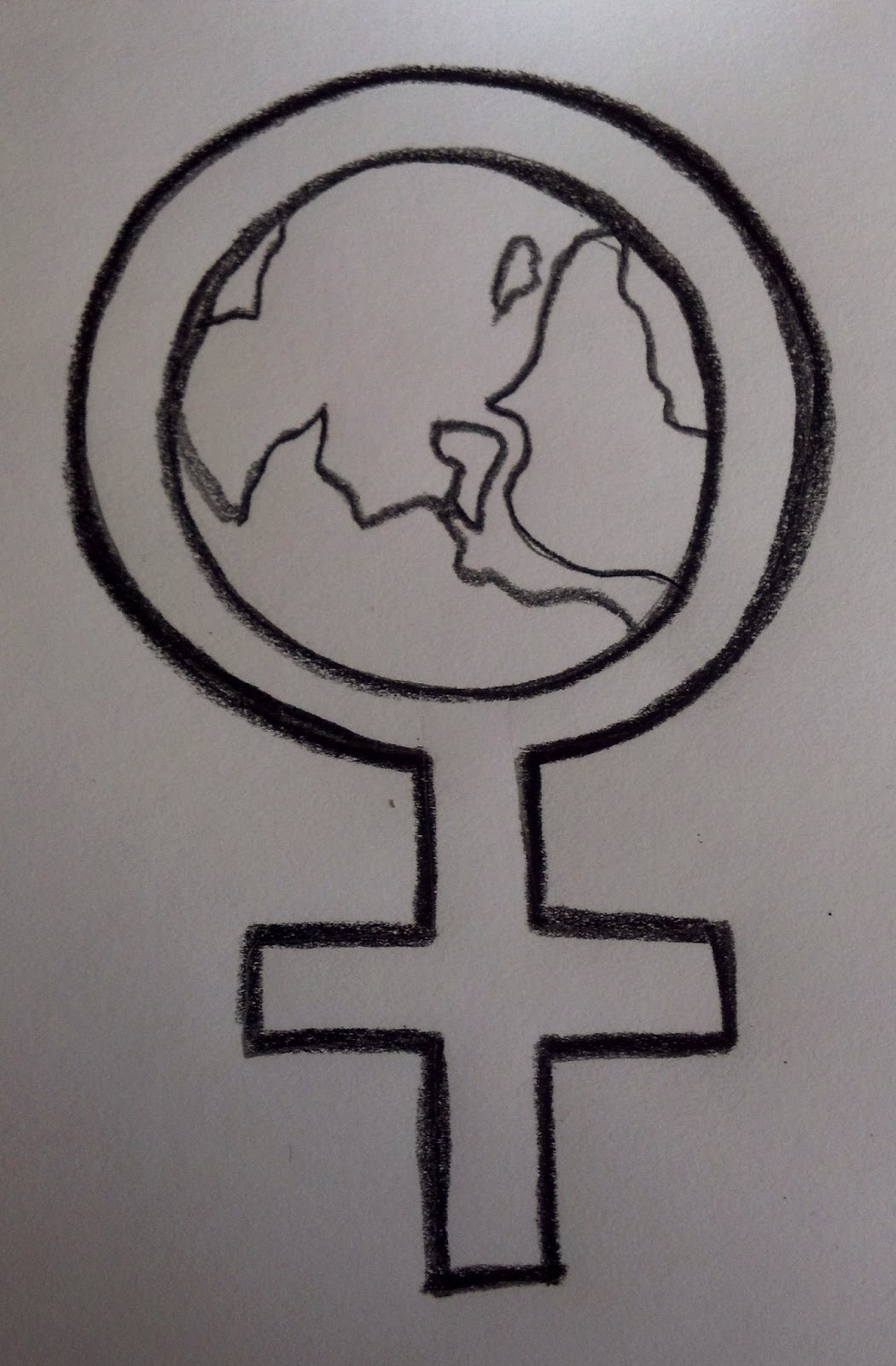
To my awesome readers,
Thank you for being a part of this semester as I have learned and grown in so many ways. This is my final post for this class (though I will try to continue posting in my post-grad life as well!), and I hope it serves to tie together some thematic strings of these reflections. Today's post is a little different, however. It is a "Manifest@" - a profession of my beliefs and commitment to working toward achieving the change I want to see in the world. I wrote the following (longer than usual) document in collaboration with Monzong Cha and Lauren Kramer. Together we comprise the "Miscellaneous Marxists," which is a nickname we acquired during the course of this class because of our mutual focus on broader systems of oppression, even in micro-scale analyses. I hope you enjoy and, more importantly, actively engage with what we've composed.
 |
| The Miscellaneous Marxists |
 |
| "our own lived experience" |
We are the
Miscellaneous Marxists, a group of students who believe that the way capitalism
manifests itself in our world is inherently oppressive and contributes to every
issue that we have encountered throughout this course. We are
“Miscellaneous” because we each come to this collective with our own lived
experience, perspective, and passion.
This is a
“Manifest@” because language reflects culture, and we want to subvert the
Western inclination toward linguistic androcentrism: the mistaken belief that the
male stands for the whole. When we repeat androcentric phrases, we validate
androcentrism.
 |
| "everyone is welcome" |
The purpose of
this manifest@ is to declare what we believe, expose the problems that feminism
must confront, and propose ways of enacting change. We identify as
revised radical Marxist anti-racist feminists, and we recognize that every
liberation is tied up with every other liberation.
The Manifest@
1. The biggest issues facing women today are
structural in nature. The oppression we experience is not only
individual, but also systemic and institutional. We reject liberal
feminism, which preserves oppressive patriarchal structures, simply aiming to
bring women “up” to the normalized status of (a certain type of) men in
society, rather than challenging hierarchy itself. We reject choice
feminism, which posits that any “choice” a woman makes is a feminist choice
because it refuses to acknowledge the constraints on women’s options and avoids
the fact that the personal is political.
 |
| "inextricably interconnected" |
2. All systems of oppression are inextricably
interconnected and cannot be treated as isolated phenomena. These systems
include racism, sexism, heterosexism, ableism, ageism, classism, cis-sexism,
and every other way that a group of people are privileged or disempowered
because of their identity. These oppressive structures have infiltrated
every facet of our lives, even the way we speak about them.
3. In the process of our liberation, we recognize, validate,
and hold to be central, the voices and experiences of trans*, lesbian,
bisexual, queer, genderqueer, intersex, asexual, and other marginalized groups
and individuals within the feminist community. Their issues are our
issues regardless of whether or not we belong to those categories ourselves.
4. We must free ourselves of the oppressive ideologies that
have pervaded our cultures and our own minds. To do so, we must actively
decolonize and decapitalize our minds, liberating ourselves of patterns of
thought and action that perpetuate the systems we will eliminate.
 |
| "continually self-reflective" |
5. Our liberation will necessitate constant intentionality.
We must be continually self-reflective so that we are conscious of the
implications of all we do. There must be purpose to each of our actions,
and the action must match our values to the fullest extent. We consider
our means to be equally as important as our ends, which involves perpetually
cultivating and practicing mindfulness.
 |
| "Education reform is essential to liberation" |
6. Education reform is essential to liberation. This
begins with access. Education, including higher education, needs to be free for
all and equipped to support all students. It is immoral and unacceptable to
fund schools differently based on property tax revenues or student performance
rates. We must equally distribute resources, including teachers, to each
school to ensure that all students have at least comparable learning
environments. In addition to access, we demand that the curriculum taught in
the classroom and the way this curriculum is presented validates a variety of
peoples and experiences, not just white male imperialist patriarchs.
 |
| "demolish the prison-industrial complex" |
7. We must demolish the prison-industrial complex and the
existence of privatized prisons. The United States has the world’s
highest incarceration rate. The system of mass incarceration is a system
of racial control that traps poor people of color in second-class status for a
lifetime. Policies that encourage racial profiling need to be eliminated
because they contribute to the unjust mass incarceration of people of color,
and in addition, they are not grounded in fact. Ex-felons should not have
their basic rights, especially the right to vote, taken away because of their
status.
8. Everyone has the right to live comfortably without
having to worry about meeting their basic needs. The wealthiest U.S. households
need to contribute their fair share to the benefit of the rest of the
population. We must tax unearned income at the same rate as earned income and
return to the taxation rates effective in 1953, in which the wealthiest portion
of U.S. earners paid a top tax rate of 92%. In addition to altering taxation
rates, we also must reconsider the way our tax dollars are utilized. We
must employ fair redistribution practices so that the lower-income members of
our society are able to live the lives they deserve.
 |
| "Healthcare is a human right" |
9. Healthcare is a human right. Everyone should receive
high-quality and free care, which includes not only biomedical treatment, but
also preventative and overall wellness care. We unequivocally demand
reproductive rights, including the right to contraception, safe, legal
abortion, prenatal care, and postnatal care, regardless of age, gender, marital
status, or any other factor. We also believe that the production and
distribution of a male contraceptive pill is of vital importance to the liberation
of women.
10. Corporate media limits the audible spectrum of voices
and conversations heard by the broader populace. The mainstream media is
increasingly and unacceptably implicated with economic and political elites,
refusing to confront those same people who hold power. Independent media
breaks down the barriers to equal representation, opening access for marginalized
people to speak for and accurately represent themselves. Dominant media
conglomerates must be broken up, and the number of channels and stations that
are owned by corporations must be matched by those owned by independent
collectives.
 |
| "prioritize demilitarization" |
11. As a collective committed to nonviolence, we demand that
our communities and our nation abide by the same principle. We prioritize
demilitarization of the United States because the military industrial complex
squanders resources, destroys peoples and the planet, and maintains
exploitative imperialist colonial practices. We demand to cut the
military budget by at least 50% and redistribute that money to fund a federal
jobs program; to close overseas bases and end the corporate natural
resource-driven wars, attacks, and conflicts; and to teach non-violent conflict
resolution and the value of consensus-based decision-making.
 |
| "enable us to create" |
12. We demand election reform in order to enable us to
create the society that we want. We must eliminate the two-party stranglehold
and the Electoral College, abolish the Commission on Presidential Debates,
introduce an Election Day national holiday and extend the voting period over a
weekend, prohibit corporate funding of any candidate or party, and amend the
constitution to ban corporate personhood.
13. These points are just the beginning of the large-scale
revolution for which we stand. We have extremely large goals, and we are
conscious and proud of that fact. In order to make these changes happen, we are
willing to take small steps to get there (if necessary). We will be intentionally
straightforward; we will not sugar-coat our stances and experiences. We refuse
to skirt around issues that need to be dealt with openly and explicitly:
we are calling out the faults of our society, and we are calling on our
society to change them.
 |
| "we are calling on our society to change" |